📦 Στείλε Δέμα — Δες Τιμή Άμεσα
Shipping from Greece to Italy: Prices, Times & Guide
No Comments
Shipping from Greece to Italy is one of our most popular routes — and one of the fastest: Express deliveries reach Rome, Milan, Naples, Florence or the smallest Sicilian village in 1-3 working days. Fully door-to-door with DHL Express: a courier collects from your place, the recipient signs at their doorstep, and you see a final price with VAT within the first 30 seconds.
Shipping from Greece to Italy: prices (final, VAT included)
- Envelope: €26.90
- Parcel 2 kg: €33.90 Express
- Parcel 5 kg: €49.90 Economy / €59.90 Express
- Parcel 10 kg: €60.90 Economy / €85.90 Express
- Suitcase 23 kg: €88.90 Economy
Italy follows our single European price list — identical to Germany and France. Every weight is on the international price list, refreshed automatically every week.
Delivery times
Express: 1-3 working days — northern Italy often receives next-day. Economy: 3-6 working days by road, the smart deal for parcels above 5 kg. Full tracking on both, from pickup to signature.
Shipping from Greece to Italy in 3 steps — powered by AI
- Photograph your parcel with an A4 sheet next to it — the AI estimates dimensions and weight.
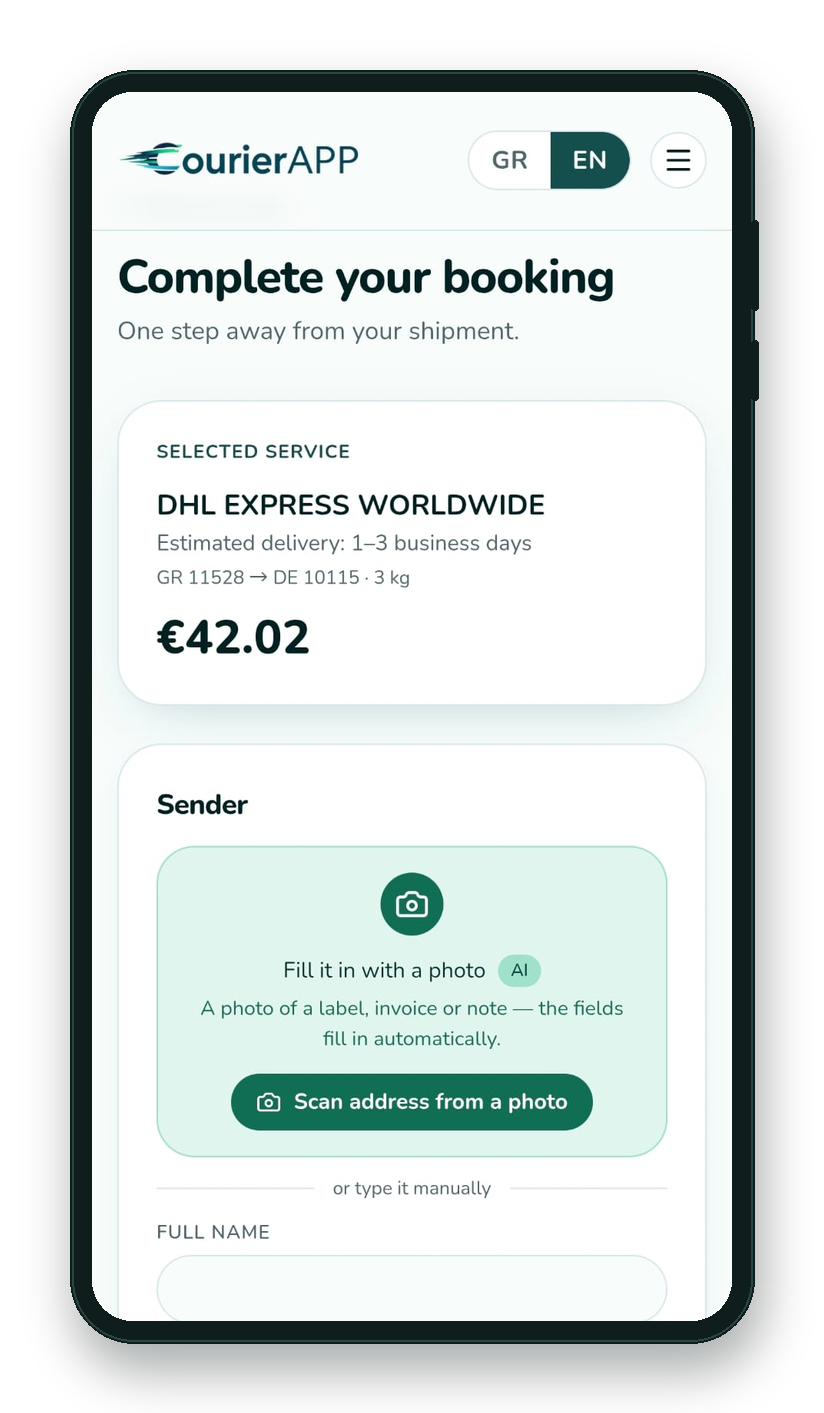
- Scan the address from a label or invoice — Italian CAP codes fill themselves in.
- Pay the final price — the courier comes to you.
We are Greece’s first AI-powered courier app — see it in action on Ship a parcel with AI.
What people send to Italy
Students in Bologna and Padua waiting for the box from home. Greek products for family and friends — olive oil, honey, cheese (properly packed). B2B samples and documents for Italian companies. And e-shops serving the biggest market next door, with tracking their customers can follow too.
Moving or on Erasmus? The Economy Suitcase up to 23 kg (€88.90) travels door-to-door while you fly with hand luggage only.
EU = zero customs
No declarations, no duties, no hidden fees. Chargeable weight = the greater of actual and volumetric (L×W×H÷5000) — the app calculates and shows it before you pay. Packing tips on our France page; the delivery network is described at DHL.
How the price of shipping from Greece to Italy is calculated
Italy is one of the easiest lanes out of Greece: it sits inside the EU customs union, it is served by both DHL and FedEx, and it offers a genuine choice between Express and Economy. That choice is where most of the savings live.
The price itself is built from the chargeable weight of your parcel and the service level. Chargeable weight is whichever is higher between the actual weight on the scale and the volumetric weight derived from the box dimensions. A bulky, light box of clothing almost always bills on volume.
Measure the sealed box rather than the contents — tape, filler and the carton itself all count. If you would rather not hunt for a tape measure, photograph the box with an A4 sheet next to it and let the AI produce the dimensions as a starting estimate that you confirm. The full toolkit is explained in our guide to shipping a parcel with AI.
Express or Economy?
Express is the fastest option and the right call for documents, samples and anything time-sensitive. Economy trades a day or two of transit for a lower price and suits personal parcels, gifts and non-urgent e-commerce orders.
The gap widens as the parcel gets heavier. On a 10 kg box the Economy service comes in at €60.90 against €85.90 for Express, both with VAT. For a 23 kg suitcase, Economy at €88.90 is usually the sensible default unless someone is waiting for it.
Delivery times and tracking
Parcels collected in Athens or Thessaloniki typically clear the Greek hub the same evening and move to the Italian network via a European gateway. Express shipments to Milan, Rome, Turin and Naples usually arrive within a couple of business days, with Economy adding a day or two.
We do not promise a guaranteed delivery date, and you should be wary of anyone who does. Strikes, weather and public holidays on either side all affect transit, and southern Italian islands add a leg regardless of carrier. What you always get is a tracking number generated with the label and a scan at every handover.
Sardinia, Sicily and smaller island destinations are served, but plan for extra days rather than assuming mainland timings. The same applies to remote Alpine postcodes in the north.
Shipping from Greece to Italy: no customs, but paperwork still matters
Because both countries are in the EU customs union, there is no customs declaration, no duty and no import VAT on goods moving from Greece to Italy. This removes the single biggest source of delay on non-EU lanes.
That does not mean documentation is irrelevant. The address must be complete, including the CAP postcode, the province abbreviation in brackets and the building or apartment detail. Italian addresses frequently include an interno or scala reference, and leaving it out is a common cause of failed delivery attempts.
A reachable phone number and email for the recipient matter just as much. Italian couriers routinely call ahead for residential deliveries, and a parcel with no answerable contact goes back to the depot.
Business shipments and e-commerce
Greek e-shops selling into Italy benefit from the same simplicity: no customs formalities, predictable transit, and a single tracked shipment per order. Keep a commercial invoice in your own records for accounting purposes even though the carrier does not need one for the border.
If you are shipping regularly, standardise on two or three box sizes. Consistent dimensions make your costs predictable and let you quote shipping to customers accurately instead of guessing.
What you can and cannot send
Most everyday items travel without any special handling: clothing, footwear, books, cosmetics in retail packaging, sealed food products, olive oil in commercial packaging, electronics with batteries installed in the device, documents and personal effects.
Restricted or prohibited on air networks regardless of the EU status: loose lithium batteries and standalone power banks, aerosols, flammable liquids and solvents, large volumes of perfume or alcohol, live plants and seeds, weapons and replicas, and cash.
Fresh and homemade food is the grey area worth avoiding. Sealed retail packaging with a full label is fine. Homemade preserves, unlabelled cheese or loose herbs risk being refused at acceptance, and there is no customs officer to blame — it is the air network rules that apply.
Sending several parcels in one booking
A single booking now covers up to 10 parcels. Use the “Add parcel” button in the form, enter dimensions and weight for each box, and you receive one combined price with VAT and a separate tracking number for every piece.
This is genuinely useful for relocations to Italy, for students starting a semester in Bologna or Milan, and for small producers sending a spread of samples to an Italian buyer. One pickup, one payment, individual visibility per box.
It is also a pricing tool. Two medium cartons frequently cost less than one oversized one, because volumetric weight rises sharply past certain dimensions. Price both arrangements before sealing anything.
Cost-saving checklist for shipping from Greece to Italy
- Choose Economy unless the shipment is genuinely time-critical — the saving is largest on heavier boxes.
- Right-size the carton. Empty space is billable volume, not free padding.
- Weigh and measure after sealing, never before.
- Use soft contents as cushioning where possible instead of adding bulk.
- Consolidate multiple boxes into one booking rather than creating separate shipments.
- Strip old labels and barcodes off reused cartons so automated sorters do not misroute the parcel.
- Confirm the CAP and the province code before you book — a wrong postcode is the most common reroute.
Common mistakes when shipping from Greece to Italy
Guessing dimensions instead of measuring. A few centimetres either way can move the parcel into a higher weight band and change the price.
Incomplete Italian addresses. Missing the interno, the scala or the province abbreviation causes more failed deliveries on this lane than anything else.
Choosing Express by reflex. On a heavy, non-urgent parcel the Economy service saves a meaningful amount for a difference of a day or two.
Assuming the quoted price can change arbitrarily. It cannot. The carrier reweighs and remeasures the parcel at the hub, and if there is a genuine discrepancy only the difference is adjusted rather than the whole shipment being re-priced.
Packing fragile goods for a car journey rather than an air network. Olive oil bottles need individual protection and a sealed bag each, and anything breakable needs five centimetres of cushioning on every side.
Who ships between Greece and Italy
The Greece–Italy corridor is one of the busiest in the Mediterranean. Greek students in Italian universities, families split between the two countries, and travellers who bought more than their suitcase could hold all use it constantly.
On the business side, Greek producers of olive oil, honey, cosmetics and textiles ship samples and small wholesale orders to Italian buyers, while e-shops fulfil individual customer orders directly. If you are comparing options across Europe, our guides to shipping from Greece to France and shipping from Greece to the Netherlands cover the neighbouring lanes, and the cheapest way to send a parcel abroad from Greece sets out the packing principles that apply on all of them.
Forgot something at your hotel in Greece?
Italian travellers who leave an item behind at a Greek hotel, villa or Airbnb can use our Lost and Found service. The traveller pays online, the property gets a prepaid label by email at zero cost to them, and a courier collects the item. No account required, and the final price with VAT is shown before payment.
Booking in practice
Shipping from Greece to Italy takes well under a minute of input. Photograph the address label or invoice so the AI can read the recipient details, photograph the sealed box beside an A4 sheet for the dimensions, and describe the contents so the app can estimate the weight.
Everything the AI fills in stays editable, the photos are used only to calculate that specific shipment, and the final price with VAT appears before you pay. Quotes come from DHL and FedEx across 220+ destinations worldwide, so the same flow works whether the parcel is going to Milan or to Melbourne.
Packing standards and insurance for shipping from Greece to Italy
An international parcel is handled far more times than a domestic one. It goes through automated sorters, gets stacked in aircraft containers, and rides on trucks at both ends of the journey. Pack for that, not for a careful hand-delivery.
Use a double-wall carton for anything heavy or fragile, and leave at least five centimetres of cushioning on every side so nothing touches the outer wall. Seal every seam with proper packing tape in an H pattern rather than one strip across the middle.
Bottles need individual protection and a sealed plastic bag each, so a breakage does not soak the rest of the contents or neighbouring parcels. Electronics travel best in their original retail box, placed inside a slightly larger shipping carton with padding around it.
What insurance actually covers
Standard carrier liability on international services is limited and calculated by weight rather than by what the contents are worth. If you are sending something valuable, add declared-value cover at the booking stage instead of assuming the base service protects it.
Cover applies to the value you declare, so keep a receipt or invoice for anything expensive. A claim without proof of value rarely succeeds. Photographing the packed contents before sealing the box is the simplest evidence you can create, and it takes ten seconds.
Some categories sit outside cover on almost every network, including cash, jewellery above a threshold, and irreplaceable items such as original documents or artwork. If something genuinely cannot be replaced, a courier network is not the right channel for it.
Italian destinations and what to expect
The northern industrial belt — Milan, Turin, Bologna, Verona — has the densest courier coverage in Italy and the most predictable transit from Greece. Business addresses in these cities are typically the fastest deliveries on the lane.
Rome, Florence and Naples are well served but add urban complexity: restricted traffic zones in historic centres, buildings without lifts, and addresses that need an interno number to be findable at all. Give the courier as much detail as you can.
Sicily, Sardinia and the smaller islands involve an additional transfer leg. They are fully served, but build extra days into your expectations and avoid promising a recipient a specific date.
Seasonal timing
August is the month to plan around. Much of Italy closes for Ferragosto in the middle of the month, business addresses go quiet, and volumes at the hubs are unpredictable either side of it. December brings the opposite problem: peak e-commerce volume across the whole network.
If your shipment is flexible, the quietest and most reliable windows are late January to March and mid-September to November. Booking a pickup early in the week also helps, since a Friday collection often waits for Monday processing at the destination.
Shipping from Greece to Italy: a step-by-step walkthrough
Start by packing and sealing the box completely. Every measurement and weight you enter later should describe the finished parcel, because that is what the carrier will put on the scale.
Open the app and photograph the recipient address — a printed label, an invoice, even a clearly written note works. The AI reads the fields and fills them in, and you check them against the original before moving on. Italian addresses in particular need the interno, the CAP and the province code.
Next, photograph the sealed box with an A4 sheet lying flat on the same surface next to it. The green frame guide in the camera helps you line up the shot. The AI returns length, width and height as an estimate, and you adjust anything that looks off.
Describe the contents in plain language so the app can estimate the weight, then review the quotes. You will see Express and Economy options from both DHL and FedEx, each with the final price including VAT.
Choose a service, pick a pickup slot, and pay. The label and tracking number are issued immediately, and the courier collects from your address. Shipping from Greece to Italy really is that short a process once the box is ready.
If something goes wrong
Failed delivery attempts are the most common hiccup, and they are almost always an address problem. Contact support with the tracking number as soon as you see the event, because the parcel can usually be redirected before it goes back to the origin depot.
For damage, keep the packaging. A claim needs photographs of both the outer carton and the contents, and discarding the box before documenting it is the fastest way to lose a legitimate claim.
Shipping from Greece to Italy: FAQ
How much does shipping from Greece to Italy cost?
An envelope from €26.90, a 5 kg parcel €49.90 with Economy or €59.90 with Express, a suitcase up to 23 kg from €88.90. Final prices, VAT included.
How long does delivery to Italy take?
Express delivers in 1-3 working days to Rome, Milan, Naples and all of Italy — northern cities often next-day thanks to proximity. Economy travels by road in 3-6 working days.
Do I need customs documents for Italy?
No — Italy is an EU country. No customs clearance, no duties, no declarations. The app price is the final price.
Send your first parcel to Italy from app.courierapp.gr — code COURIER5 gives you €5 off.