📦 Στείλε Δέμα — Δες Τιμή Άμεσα
Shipping from Greece to France: Prices, Times & Guide
No Comments
Shipping from Greece to France with CourierAPP is fully door-to-door: a courier collects from your place anywhere in Greece and delivers to the recipient’s doorstep in Paris, Lyon, Marseille or Bordeaux through the DHL Express network. You see a final price with VAT in 30 seconds — no queues, no counters, no “call us for a quote”.
Shipping from Greece to France: prices (final, VAT included)
- Envelope: €26.90
- Parcel 2 kg: €33.90 Express
- Parcel 5 kg: €49.90 Economy / €59.90 Express
- Parcel 10 kg: €60.90 Economy / €85.90 Express
- Suitcase 23 kg: €88.90 Economy
France follows our single European price list — the same rates as Germany and the rest of the EU. See every weight on the international price list; prices refresh automatically every week, so what you read here is what you pay.
How fast is it?
With Express your parcel arrives in 1-3 working days — Paris usually in 2. With Economy it travels by road in 3-6 working days at a noticeably lower cost for heavier parcels. Both services include full tracking from pickup to signature via app.courierapp.gr.
Shipping from Greece to France in 3 steps — powered by AI
- Photograph your parcel with an A4 sheet next to it — the AI estimates dimensions and weight, you just confirm.
- Scan the address from a label or invoice photo — zero typing of French street names and accents.
- See the final price and pay — the courier comes to you.
We are Greece’s first AI-powered courier app — see how it works on Ship a parcel with AI.
What people send to France
Greek students at French universities waiting for the monthly box from home — olive oil, coffee, sweets, seasonal clothes. Families sending gifts. Professionals shipping samples and documents to clients. And e-shops selling to French customers who want tracked, reliable delivery without building their own logistics team.
For moves and Erasmus semesters, the Economy Suitcase up to 23 kg (€88.90) is almost always cheaper than airline excess baggage — and nobody has to drag it through an airport.
No customs, no surprises
France is an EU member: no customs clearance, no duties, no content declaration. Chargeable weight is the greater of actual and volumetric weight (L × W × H ÷ 5000) and the app shows it before you pay. Packing tips: double-wall boxes for fragile items, filler in the gaps, H-taped seams — see more on our Germany page; the delivery network is described at DHL.
How the price of shipping from Greece to France is calculated
France is a straightforward lane out of Greece. It sits inside the EU customs union, it is covered by both DHL and FedEx, and it offers a real choice between Express and Economy — which is where most of the money is saved or lost.
The price is built from the chargeable weight of the parcel and the service you pick. Chargeable weight is whichever is higher between the scale reading and the volumetric weight calculated from the box dimensions. A big, light box of clothing bills on volume almost every time.
Measure the box once it is sealed, because tape, filler and the carton all count towards the total. If you would rather skip the tape measure, photograph the box next to an A4 sheet and let the AI produce the dimensions as a starting estimate that you confirm. Our guide to shipping a parcel with AI covers the full toolkit.
Express or Economy?
Express is the right choice for documents, samples and anything with a deadline attached. Economy trades a day or two of transit for a lower price and suits gifts, personal parcels and non-urgent orders.
The saving scales with weight. A 10 kg box costs €60.90 on Economy versus €85.90 on Express, both with VAT. A 23 kg suitcase on Economy at €88.90 is usually the sensible default unless someone is waiting for it.
Delivery times and tracking
Parcels collected in Athens or Thessaloniki normally clear the Greek hub the same evening and enter the French network through a European gateway. Express shipments to Paris, Lyon, Marseille, Toulouse and Bordeaux typically arrive within a couple of business days, with Economy adding a day or two.
We do not promise a guaranteed date, and it is worth being sceptical of anyone who does. Industrial action, weather at the northern hubs and public holidays on either side all affect transit. What you always get is a tracking number issued with the label and a scan at every handover.
Corsica and the overseas departments are a separate matter. Corsica adds a leg and extra days, while Guadeloupe, Martinique, Reunion and French Guiana have their own customs treatment and should never be assumed to work like mainland France.
Shipping from Greece to France: no customs, but details still matter
Both countries are inside the EU customs union, so there is no customs declaration, no duty and no import VAT on goods moving from Greece to France. The largest source of delay on non-EU lanes simply does not exist here.
Address quality takes its place as the thing worth getting right. French addresses need the building number, the street type spelled correctly, the five-digit code postal and the town. Apartment blocks also need the batiment, escalier or appartement detail, and a digicode where one exists.
A reachable phone number matters more in France than on most lanes, because couriers frequently call ahead for residential deliveries and buildings with entry codes are common. A parcel with no answerable contact tends to go back to the depot.
Business and e-commerce shipments
Greek e-shops selling into France get the same simplicity: no border formalities, predictable transit and full tracking on every order. Keep a commercial invoice in your own records for accounting even though the carrier does not need one at the border.
If you ship regularly, standardise on two or three carton sizes. Predictable dimensions make costs forecastable and let you quote shipping to customers accurately rather than absorbing surprises on each order.
What you can and cannot send
Everyday items travel without special handling: clothing, footwear, books, cosmetics in retail packaging, sealed food products, olive oil in commercial packaging, electronics with batteries fitted inside the device, documents and personal effects.
Restricted or prohibited on air networks regardless of EU status: loose lithium batteries and standalone power banks, aerosols, flammable liquids and solvents, large volumes of alcohol or perfume, live plants and seeds, weapons and replicas, and cash.
Food is the usual grey area. Sealed retail packaging with a full ingredient label travels fine, which covers most Greek products people want to send. Homemade preserves, unlabelled cheese and loose herbs risk refusal at acceptance — and that is air network policy, not customs.
Sending several parcels in one booking
A single booking now covers up to 10 parcels. Press “Add parcel” in the form, enter dimensions and weight for each box, and you receive one combined price with VAT plus an individual tracking number per piece.
It is genuinely useful for relocations, for students starting a year in Paris, Lyon or Montpellier, and for producers sending a range of samples to a French buyer. One pickup, one payment, visibility on every box separately.
Treat it as a pricing tool as well. Two medium cartons often cost less than one oversized carton, because volumetric weight rises sharply past certain dimensions. Price both arrangements in the app before sealing anything.
Cost-saving checklist for shipping from Greece to France
- Choose Economy unless the shipment is genuinely time-critical — the gap is widest on heavy boxes.
- Right-size the carton. Empty space is billable volume, not free padding.
- Weigh and measure after sealing, never before.
- Use clothing and soft goods as cushioning instead of adding bulky filler.
- Consolidate boxes into one booking rather than creating separate shipments.
- Strip old labels and barcodes from reused cartons so automated sorters do not misroute the parcel.
- Confirm the code postal and any building or entry code before booking.
Common mistakes when shipping from Greece to France
Estimating dimensions by eye. A few centimetres of error can move the parcel into a higher band and change what you pay.
Incomplete French addresses. Missing the batiment, escalier or digicode causes more failed attempts on this lane than anything else.
Reaching for Express by reflex. On a heavy, non-urgent parcel the Economy service saves a meaningful amount for a difference of a day or two.
Assuming the quoted price can change arbitrarily. It cannot. The carrier reweighs and remeasures at the hub, and where there is a real discrepancy only the difference is adjusted rather than the shipment being re-priced from scratch.
Packing for a car journey instead of an air network. Bottles need individual protection and a sealed bag each, and anything breakable wants five centimetres of cushioning on every side.
Packing standards and insurance
An international parcel is handled many more times than a domestic one, passing through automated sorters, aircraft containers and trucks at both ends of the trip. Pack for that reality.
Use a double-wall carton for anything heavy or fragile, leave at least five centimetres of cushioning all round so nothing touches the outer wall, and tape every seam in an H pattern rather than a single strip across the middle.
Standard carrier liability on international services is limited and calculated by weight, not by what the contents are worth to you. For valuable items add declared-value cover at booking and keep a receipt, because a claim without proof of value rarely succeeds. Photographing the packed contents before you seal the box takes seconds and is the easiest evidence to produce later.
French destinations and seasonal timing
Paris and the Ile-de-France region have the densest coverage and the most predictable transit from Greece. Lyon, Marseille, Toulouse, Bordeaux and Lille are all well served with only marginal differences.
Rural addresses in the Massif Central, the Alps and parts of Brittany can add a day, and mountain communes in winter add more. Corsica is fully served but should always be planned with extra days.
August is the month to work around. Much of France closes for the summer holidays, business addresses go quiet, and volumes either side of the break are unpredictable. December brings peak e-commerce load instead. The calmest windows are late January to March and mid-September to November.
Who ships between Greece and France
Greek students at French universities and grandes ecoles, professionals working in Paris and Lyon, and families split between the two countries keep this corridor busy all year.
Commercially, Greek producers of olive oil, honey, cosmetics and textiles send samples and small wholesale orders to French buyers met at trade fairs, and e-shops fulfil individual customer orders directly. For neighbouring lanes see our guides to shipping from Greece to Italy and shipping from Greece to Germany, plus the cheapest way to send a parcel abroad from Greece for packing principles that apply on all of them.
Left an item behind in Greece?
French travellers who forget something at a Greek hotel, villa or Airbnb can use our Lost and Found service. The traveller pays online, the property receives a prepaid label by email at no cost to them, and a courier collects the item. No account is needed and the final price with VAT is shown before payment.
Booking in practice
Shipping from Greece to France takes under a minute of actual input. Photograph the address label or invoice so the AI can read the recipient details, photograph the sealed box beside an A4 sheet for the dimensions, and describe the contents so the app can estimate weight.
Everything the AI fills stays editable, the photos are used only to calculate that specific shipment, and the final price with VAT appears before you pay. Quotes come from DHL and FedEx across 220+ destinations worldwide, so the same flow works for Paris and for anywhere else.
Shipping from Greece to France: a step-by-step walkthrough
Pack and seal the box first. Every measurement and weight you enter afterwards should describe the finished parcel, because that is exactly what the carrier will put on the scale at the hub.
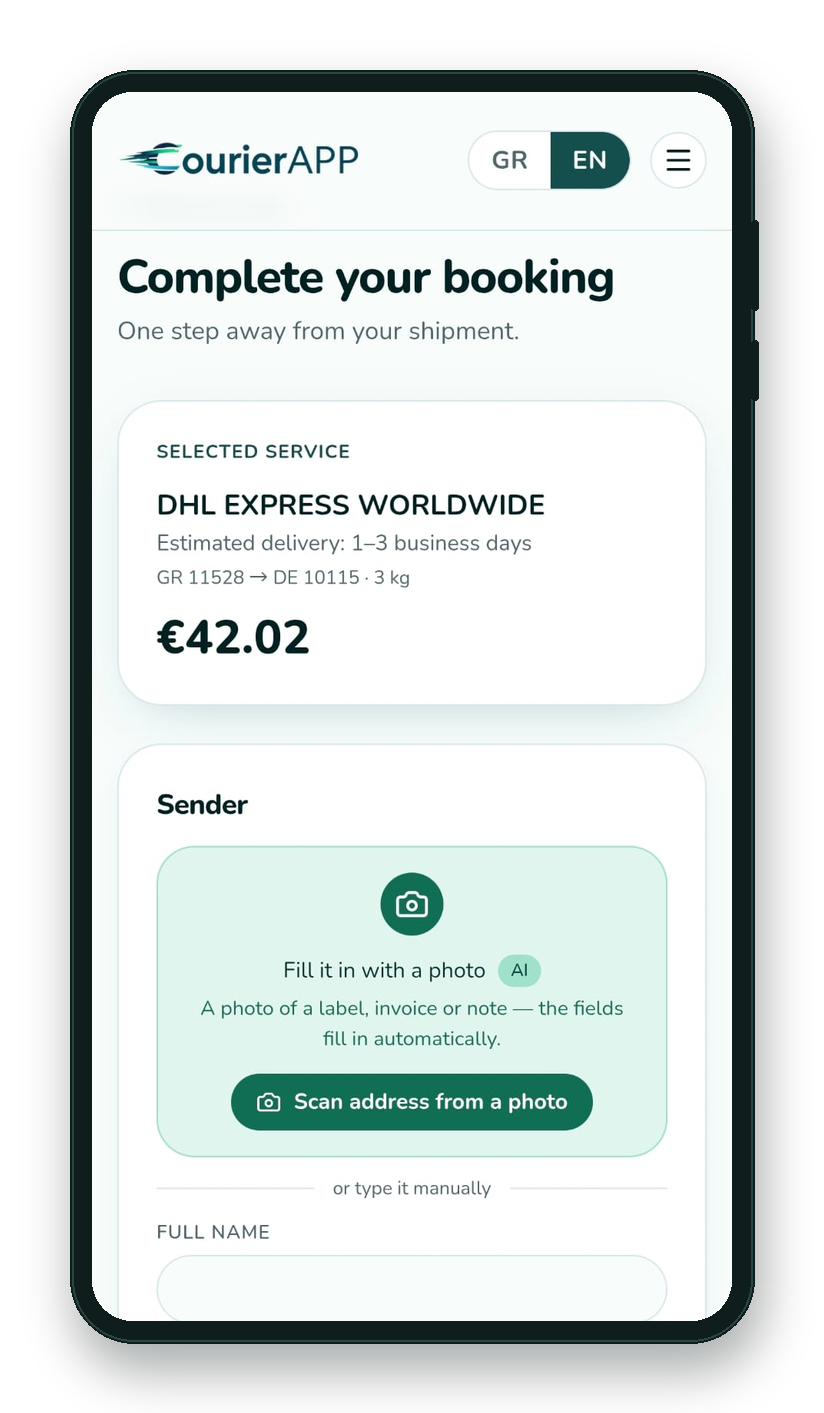
Open the app and photograph the recipient address. A printed label, an invoice or a clearly written note all work — the AI reads the fields and fills them in, and you check them against the original. For French addresses, confirm the code postal and any building, staircase or entry-code detail.
Then photograph the sealed box with an A4 sheet lying flat on the same surface beside it. The green frame guide in the camera lines the shot up for you. The AI returns length, width and height as an estimate, and you correct anything that looks wrong before continuing.
Describe the contents in plain language so the app can estimate the weight, then compare the quotes. You will see Express and Economy options from both DHL and FedEx, each showing the final price with VAT included.
Choose a service, pick a pickup slot and pay. The label and tracking number are issued immediately and a courier collects from your address, usually the same or the next working day. Shipping from Greece to France really is that short a process once the box is ready.
If something goes wrong
Failed delivery attempts are the most common issue and are almost always an address problem. Contact support with the tracking number as soon as the event appears, because a parcel can usually be redirected before it heads back to the origin depot.
For damage, keep the packaging. A claim needs photographs of both the outer carton and the contents, and discarding the box before documenting it is the fastest way to lose an otherwise valid claim.
Timing your pickup
Book a collection early in the week where you can. A parcel handed over on Monday or Tuesday has the full working week ahead of it, while a Friday collection often waits for Monday processing at the destination regardless of the service level you paid for.
Shipping from Greece to France: FAQ
Tracking Your Parcel to France
Once your shipping from Greece to France booking is confirmed, you receive a tracking code that updates at each stage — pickup, transit hub and final delivery. Both DHL and FedEx are available as carriers, so you can compare live rates and delivery windows before you book, then follow the shipment in real time from the same dashboard until it’s signed for in France.
Sending Several Parcels to France at Once
If you need to send more than one box — for example when relocating or restocking a small business — the booking form lets you add up to 10 parcels in a single order, each with its own tracking code but one combined price. This is faster than creating separate bookings and keeps every parcel on the same pickup, which matters when you’re shipping from Greece to France on a deadline.
How much does shipping from Greece to France cost?
An envelope from €26.90, a 5 kg parcel €49.90 with Economy or €59.90 with Express, and a suitcase up to 23 kg from €88.90. All prices are final, VAT included.
How long does delivery to France take?
Express delivers in 1-3 working days to Paris, Lyon, Marseille and every corner of France. Economy travels by road in 3-6 working days — the smart pick for heavier parcels.
Do I need customs documents for France?
No. France is an EU country, so your parcel travels with no customs, no duties and no paperwork — the price you see in the app is final.
Ready? Send your first parcel to France from app.courierapp.gr — use code COURIER5 for €5 off your first shipment.