📦 Στείλε Δέμα — Δες Τιμή Άμεσα
Cheapest Parcel Shipping Method: 5 Smart Easy Wins
No Comments
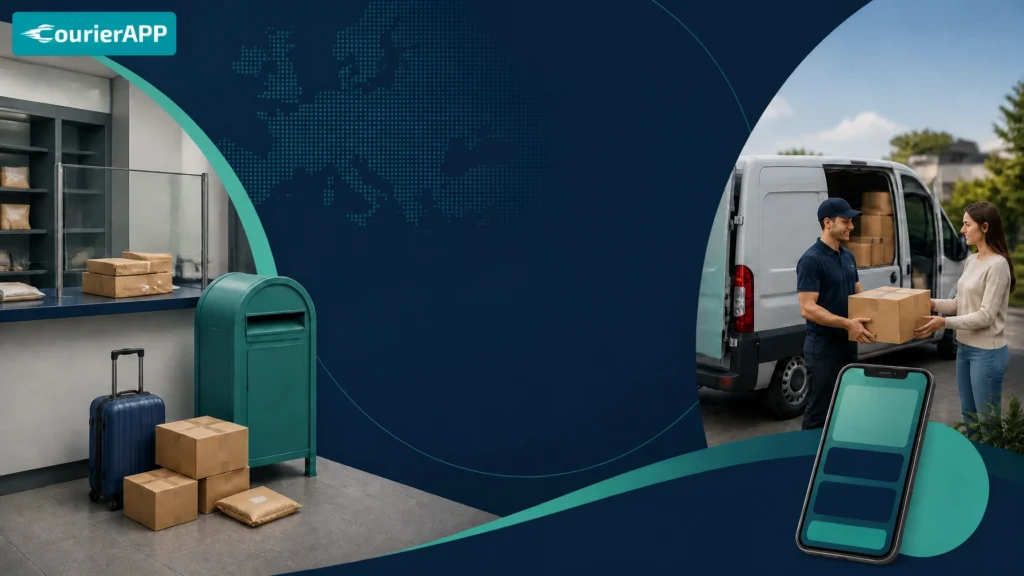
The cheapest parcel shipping method from Greece is rarely the one people assume, and it changes depending on weight, destination and how quickly the parcel has to arrive. This guide compares the realistic options side by side.
We look at the post office, traditional couriers, international express networks and app-based booking, then show where each one actually wins. CourierAPP ships door to door to 220+ destinations worldwide through DHL and FedEx, with the final VAT-inclusive price shown before you pay.
What actually determines the cheapest parcel shipping method
Four variables decide the final number, and only one of them is the courier brand.
Chargeable weight. Carriers compare actual weight against volumetric weight and charge the higher of the two. A light but bulky box is priced on the space it occupies, which is why identical contents can cost very different amounts.
Service level. Economy and Express use the same collection and the same tracking, but different transit networks. The gap between them on a 10 kg parcel to Europe is significant.
Destination zone. Cyprus, the European Union, the United Kingdom and the rest of the world sit in different pricing zones, and non-EU routes carry customs handling.
Hidden extras. Fuel surcharges, remote area fees, packaging bought at a counter and a second delivery attempt all quietly raise the real cost.
Post office versus courier: the honest comparison
The post office is often assumed to be the default budget answer. For very light items with no deadline, it sometimes is.
Its weaknesses appear as soon as the parcel matters. Tracking is coarse or stops at the border, transit times widen without warning, and you have to carry the parcel to a counter and queue.
A courier network collects from your door, scans the parcel at every handover and gives a realistic delivery window. For anything above a couple of kilos, the price difference narrows sharply while the service difference does not.
The practical answer for most people: postal for a small envelope you can afford to lose track of, courier for anything you would be upset to lose.
Real prices: finding the cheapest parcel shipping method by route
All prices below include VAT and come from the live price list, so you can compare like with like.
- Europe, 5 kg parcel, Economy: €49.90
- Europe, 10 kg parcel, Economy: €59.90
- Europe, 10 kg parcel, Express: €85.90
- Cyprus, 1 kg envelope, Express: €20.90
- United Kingdom, 10 kg parcel, Economy: €71.90
International shipping starts from €20.90, and inside Greece from €13.90 for an envelope or parcel up to one kilo. The domestic option is DHL Express Domestic, a premium next-working-day service rather than a budget one.
Notice the pattern: the jump from 5 kg to 10 kg on Economy is small, while the jump from Economy to Express at the same weight is large. Weight bands reward consolidation, service levels reward patience.
Economy versus Express: where the money really goes
Economy typically delivers in 3 to 6 working days within Europe. Express typically delivers in 1 to 3. Both are collected from your door and both are fully tracked end to end.
If nobody is waiting for the parcel, Economy is almost always the cheapest parcel shipping method available to you. The saving on a single 10 kg European shipment is often enough to cover a second parcel later in the month.
Express earns its price in three situations: a hard deadline, high-value contents you want moving through the network quickly, and destinations where a longer transit means a longer customs exposure.
Paying for Express by default is the most common way people overspend on shipping.
Seven ways to lower the price without changing courier
1. Right-size the box. Volumetric weight punishes empty space. A smaller box with the same contents can drop you a full price band.
2. Weigh before you book. Carriers reweigh everything. An optimistic estimate is corrected afterwards, so guessing never saves money.
3. Consolidate. One booking with several pieces beats several separate bookings on almost every route.
4. Choose Economy deliberately. Decide the deadline first, then pick the service, not the other way around.
5. Write a precise content description. Customs delays cost storage fees and re-delivery attempts.
6. Give a reachable phone number. A failed delivery is the most avoidable expense in shipping.
7. Reuse packaging you already own. Counter-bought boxes and tape add up quickly.
Multi-piece bookings: up to 10 parcels, one price
A single booking can now carry up to 10 parcels. The form has an Add parcel button, the price is combined, and each piece gets its own tracking number.
This matters for anyone shipping a batch: an e-shop sending a weekly run, a family relocating, or a student moving a room abroad. One collection, one payment, one set of paperwork.
It is also a quiet way to find the cheapest parcel shipping method for a large load, because splitting weight across several right-sized boxes often lands in better bands than one oversized carton.
Customs, duties and the costs people forget
Inside the European Union there is no customs clearance and no duty on personal shipments. That is why European routes stay predictable.
Outside the EU, including the United Kingdom, the United States and Switzerland, a declaration is required and duty or import VAT may be payable by the recipient. That cost is not part of the shipping price and should be discussed with them in advance.
CourierAPP prepares the customs paperwork with the carrier, so your job is limited to describing the contents honestly and giving a realistic declared value.
Vague descriptions are the leading cause of held shipments, and held shipments generate storage charges. Specific wording is free and saves money.
You can read the carrier view of international express standards on the DHL Express site.
What you cannot send, whatever the price
Some items are restricted or forbidden regardless of service, and discovering this after collection is expensive.
- Loose lithium batteries and power banks.
- Aerosols, perfumes, alcohol and flammable liquids.
- Perishable food and anything requiring refrigeration.
- Cash, jewellery and documents of monetary value.
- Weapons, replicas and pressurised containers.
Country-specific rules add to this list. Used clothing quantities, cosmetics and food supplements are all commonly restricted somewhere. Check before you seal the box.
Delivery times and tracking
Estimates are counted in working days from collection and exclude the pickup day itself. Public holidays at either end extend them.
Tracking moves through a predictable sequence: collected, origin hub, export, arrival, customs where applicable, local depot, out for delivery. A quiet day mid-transit is normal.
No courier can guarantee a date for a shipment crossing a customs border, and any that does is describing an ambition rather than a commitment.
If tracking has genuinely stalled for several working days, contact support with the number rather than waiting.
Common mistakes that cancel out your savings
Choosing a cheap headline rate that excludes fuel surcharge, then paying it later. Comparing an all-inclusive VAT price against a pre-VAT quote. Booking the slowest service for something that had a deadline after all.
Underdeclaring value to reduce duty, then having no meaningful claim when something is damaged. Using a box that was already weak from a previous journey.
And the most frequent one: not checking dimensions. Two parcels of the same weight can differ by an entire price band because one is a cube and the other is a long, awkward carton.
Let the AI do the measuring
If you do not own a tape measure or scale, the app can estimate dimensions from a single photo with a plain A4 sheet used as a ruler, and estimate weight from a description of the contents.
It is an assistant, not a replacement: you confirm the numbers, and the carrier reweighs on collection so only the difference is ever adjusted. Photos are used solely to calculate the shipment.
See how it works in our guide to measuring a parcel from a photo, and compare the wider options in courier or post office for parcels and cheap parcel delivery to Europe.
Step by step: booking in about 30 seconds
Knowing the cheapest parcel shipping method is only useful if booking it is quick. Here is the full sequence.
Choose the destination. Country and city first. No account is needed to see a price, so you can compare before committing to anything.
Add the addresses. Type them, or photograph an existing shipping label or invoice and let the AI address scanner read them. You confirm the result before it is used.
Enter weight and dimensions. Use a scale and tape measure if you have them. If not, one photo with an A4 sheet beside the box gives the AI a reference to estimate from.
Compare services. Economy and Express appear side by side with the final VAT-inclusive amount. This is the moment the real decision is made.
Book the collection. Pick a day, pay online, receive the label by email. Hand the parcel over at your door.
Follow the tracking. A number arrives immediately and updates at each scan until the parcel is signed for.
Packaging: the cheapest upgrade you can make
Packaging is where small decisions produce measurable savings, because it directly changes chargeable weight.
Use a box that fits. Cut down an oversized carton rather than filling it with air and paper. Every centimetre of unnecessary length is priced.
Choose double-wall cardboard for anything above about 5 kg. A collapsed box in transit costs far more than the box did.
Tape all seams in an H pattern, top and bottom. Parcels are handled by machines that pull at edges.
Wrap fragile contents individually rather than as a group, and keep them away from the outer walls. Damage almost always starts at a corner.
Remove or fully cover old labels and barcodes. Scanners read whatever they see, and a leftover code from a previous shipment causes genuine misroutes.
Put a card with sender and recipient details inside the box. If the outer label is destroyed, that card is what saves the parcel.
Which option wins, by scenario
A document or small envelope to Cyprus. Express is already inexpensive on this route and arrives in days rather than weeks, so it usually beats the postal alternative on value.
A 10 kg box of clothes to Germany. Economy is the clear answer. Nobody is waiting, the route is inside the EU, and there is no customs step to worry about.
Spare parts a workshop is waiting for. Express, without hesitation. Downtime costs more than the difference.
Three boxes moving abroad with a student. One multi-piece Economy booking, right-sized boxes, sent two weeks before term starts.
An e-shop order to the United Kingdom. Economy for standard orders, Express for anything promised as next week, with the customs description written carefully either way.
A parcel inside Greece that is not urgent. Honestly, a standard domestic courier will be cheaper. The DHL Express Domestic option exists for speed and door-to-door reliability, not for the lowest possible price.
Comparing quotes properly
Most comparisons fail because they compare different things. Three checks make them meaningful.
First, confirm whether VAT is included. A pre-VAT quote looks around a quarter cheaper and is not.
Second, confirm whether fuel and remote-area surcharges are already in the figure or applied later. Headline rates frequently exclude both.
Third, confirm what happens on a failed delivery. Some networks charge for each additional attempt, others hold the parcel and charge storage.
A quote that includes VAT, surcharges and collection is comparable. Anything else is a starting point for a negotiation you did not know you were in.
Tracking, proof of delivery and disputes
Keep the tracking number and the booking confirmation until the parcel has been delivered and accepted. They are the basis of any later conversation.
Proof of delivery includes a timestamp and, on most routes, a signature or a photo. Ask for it if a recipient says nothing arrived.
If a parcel is damaged, report it at delivery and photograph the packaging before opening it fully. Claims assessed later without that evidence rarely succeed.
Declared value should reflect reality. Understating it to reduce duty leaves you with compensation based on that lower figure.
A pre-booking checklist
- Box is the smallest that safely fits the contents.
- Weight and all three dimensions are measured, not guessed.
- Deadline is defined before the service is chosen.
- Everything that can travel together is in one multi-piece booking.
- Content description is specific and honest.
- Recipient phone number and email are correct and monitored.
- Nothing restricted is inside the box.
- Old labels are removed and seams are taped.
Run through it once and the cheapest parcel shipping method stops being a guess. It becomes the option that was always going to be right for that specific parcel.
Where the parcel can go: 220+ destinations worldwide
The network reaches 220+ destinations worldwide through DHL and FedEx, so route availability is rarely the constraint. What differs is paperwork and transit estimate, not the door-to-door principle.
European Union routes are the simplest: no customs step, predictable transit, and the widest gap between Economy and Express pricing. This is where choosing Economy saves the most.
United Kingdom shipments have been customs shipments since Brexit. The declaration is prepared for you, but the recipient may owe import VAT or duty, so agree who pays before booking.
Long-haul routes such as the United States, Canada and Australia are Express-led, because a slow service across a customs border compounds delay rather than saving money.
Cyprus sits in its own zone and is one of the most affordable international routes from Greece, which is why it often looks unusually cheap next to mainland Europe.
Business shipping and repeat volume
If you ship regularly, the arithmetic changes. Consistency in box sizes matters more than hunting for a lower rate on any single shipment.
Standardise on two or three carton sizes that match your typical order. Predictable dimensions mean predictable weight bands and far fewer surprises.
Batch collections rather than booking ad hoc. One pickup for the day beats several, both in cost and in the time somebody has to spend waiting.
Write a reusable, accurate content description for each product category. Customs delays hit repeat shippers hardest because the same wording is used again and again.
Track your own failure rate. Failed deliveries and returns, not headline rates, are what quietly erode margin on international orders.
Forgotten items and one-off returns
Not every shipment is planned. If a traveller leaves something behind at a hotel, villa or short-term rental in Greece, the return can be arranged online through the Lost and Found service.
The traveller pays and sees the final VAT-inclusive price before confirming. The property receives a prepaid label by email, hands the item to the courier and pays nothing at all.
Conclusion
The cheapest parcel shipping method is a decision, not a brand. Pick the right box, weigh it honestly, choose Economy unless there is a real deadline, and consolidate whatever you can into one booking.
Do those four things and the price takes care of itself, with door-to-door collection and full tracking included rather than traded away.
What is the cheapest parcel shipping method from Greece to Europe?
For most people it is an Economy courier service booked online. A 5 kg parcel to Europe starts at €49.90 with VAT included, collected from your door and tracked to delivery.
Is the post office the cheapest parcel shipping method?
Only for very light items with no deadline. Above a couple of kilos the price gap narrows while tracking, transit reliability and door collection all favour a courier network.
How do I find the cheapest parcel shipping method for several boxes?
Use one multi-piece booking with up to 10 parcels instead of separate shipments. Splitting weight across right-sized boxes usually lands in better weight bands, and you get one combined price with separate tracking per piece.