📦 Στείλε Δέμα — Δες Τιμή Άμεσα
Send a Suitcase Abroad From Greece: 7 Easy Smart Tips
No Comments
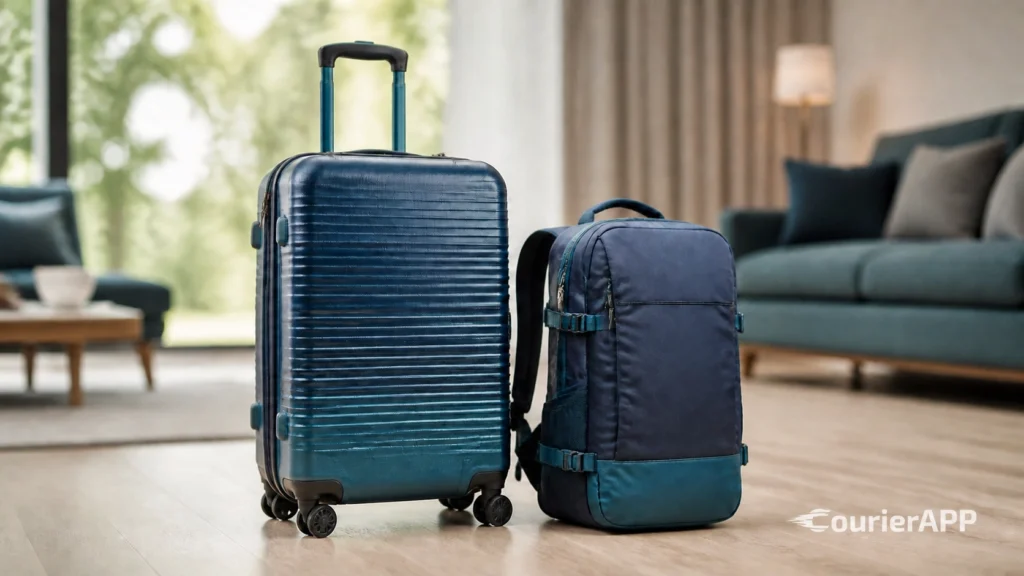
If you want to send a suitcase abroad from Greece, the process is far simpler than most people expect: you book online, a courier collects the suitcase from your door and it travels to its destination with full tracking. No post office queues, no cling film, no weighing scales.
This beginner guide walks you through every stage, from the first photo you take to the moment the suitcase is signed for. CourierAPP is the first Greek courier app with Artificial Intelligence, and it ships door to door to 220+ destinations worldwide through DHL and FedEx.
How to send a suitcase abroad from Greece in 6 steps
The whole booking takes around half a minute once you know what to expect. Here is the flow, step by step.
1. Open the app and choose the destination. Pick the country and city where the suitcase is going. You do not need an account to see a price.
2. Enter the addresses. Type them manually, or photograph a shipping label or invoice and let the AI address scanner read them for you. You always confirm the result before continuing.
3. Give the weight and dimensions. Weigh the suitcase on a bathroom scale if you have one. If not, place a plain A4 sheet next to it and photograph it: the AI measures the suitcase from that single photo, using the A4 as a ruler.
4. Review the price. The final amount, VAT included, appears in about 30 seconds. Nothing is hidden and no surcharge appears later at the door.
5. Book the pickup. Choose the day, pay online and print or email the label. Many households simply hand the courier a printed label at the door.
6. Track it. A tracking number arrives immediately and updates at every scan until delivery.
What it costs to send a suitcase abroad from Greece
Suitcase pricing is based on weight bands rather than guesswork, so you can budget before you commit. All figures below include VAT and reflect the live price list.
- Europe, 10 kg suitcase, Economy: €61.90
- Europe, 23 kg suitcase, Economy: €87.90
- Europe, 23 kg suitcase, Express: €158.90
- United Kingdom, 23 kg suitcase, Economy: €97.90
- Cyprus, 23 kg suitcase, Express: €142.90
International shipments start from €20.90 for the lightest documents and small parcels, which gives you a sense of the entry point of the network. A suitcase naturally sits higher because of its weight and volume.
Domestic shipping inside Greece is also available, from €13.90 for an envelope or a parcel up to one kilo. That service is DHL Express Domestic: premium next-working-day speed with door pickup, not a budget option.
Express or Economy: which service fits your suitcase
Both services collect from your door and both are fully tracked. The difference is transit time and price.
Economy usually lands in 3 to 6 working days within Europe. It is the popular choice for students moving for a semester, for seasonal wardrobes and for anything that is not urgent. On a 23 kg suitcase to Europe the saving against Express is substantial.
Express typically moves in 1 to 3 working days. Choose it when someone is waiting for the contents, when the suitcase carries equipment needed for work, or when you are shipping close to a deadline such as a wedding or a conference.
A practical rule: if you would be annoyed waiting a week, pay for Express. If you would not notice, Economy is the better value.
Packing: how to send a suitcase abroad from Greece safely
A suitcase is already a hard-sided container, which is a good start, but it was designed for an aircraft hold, not for a conveyor belt network.
Fill every gap. Empty space lets contents shift and lets the shell flex. Soft clothing works as free padding around anything rigid.
Protect the zip. Wrap the suitcase in stretch film or strong tape around the seam, or use a fabric cover. This also keeps the zip from catching on machinery.
Remove old airline tags and barcodes. Scanners read whatever they see first, and a leftover tag from a previous flight is a genuine cause of misroutes.
Keep liquids out. Even sealed bottles of olive oil or shampoo can open under pressure and ruin everything around them.
Attach the label flat on the largest surface, in a clear pouch if you have one. Add a small card with the recipient details inside the suitcase as a backup.
Customs, prohibited items and declared value
Inside the European Union there is no customs clearance for personal effects, so a suitcase to Germany or Italy simply travels. Outside the EU, including the United Kingdom, the United States and Switzerland, a customs declaration is required.
You describe the contents honestly in the app and CourierAPP handles the paperwork with the carrier. Vague descriptions such as gifts or personal items are the single most common cause of delay, because customs officers cannot classify them.
Declared value matters. Understating it to save a few euros leaves you with no meaningful compensation if something goes wrong, and customs may challenge an implausible figure anyway.
Items that are restricted or forbidden include lithium batteries shipped loose, aerosols, perfumes and alcohol, flammable liquids, and perishable food. Power banks and spare batteries are a frequent surprise: leave them out.
Some destinations also restrict used clothing quantities or require additional declarations. If you are unsure, ask before you book rather than after collection.
Delivery times and tracking, honestly explained
Transit estimates are working days from collection, not calendar days, and they do not include the day of pickup. Weekends and public holidays in either country extend them.
Within Europe, Express is normally 1 to 3 working days and Economy 3 to 6. Non-EU destinations add customs processing, which is unpredictable by nature. No responsible courier promises a guaranteed date for a suitcase crossing a customs border.
Tracking updates at each handover: collection, origin hub, export, arrival, customs, local depot, out for delivery. A quiet period of a day or two while the shipment is in transit between hubs is normal and not a sign of a problem.
If a status has not moved for several working days, that is the moment to ask. You can read more about international express standards directly on the DHL Express website.
7 beginner mistakes to avoid when you send a suitcase abroad from Greece
1. Guessing the weight. Carriers reweigh every shipment. If your estimate is low, the difference is adjusted afterwards. Measure properly, or let the AI give you a starting estimate from a photo.
2. Ignoring volumetric weight. A large but light suitcase is charged on the space it occupies. A smaller, denser pack is often cheaper.
3. Overpacking past the band. Going from 22.8 kg to 23.4 kg pushes you into the next price tier. Weigh before you close it.
4. Writing a vague content description. This stalls customs more often than any other single factor.
5. Leaving the old airline tag on. Cheap to remove, expensive to fix.
6. Booking Express when Economy would do. Many people pay for speed they never needed.
7. Forgetting the recipient will not be home. Give a number that will be answered, or a workplace address.
Suitcase or cardboard box? When each one wins
A suitcase wins when the contents are clothes and soft goods, when the recipient will actually use the case afterwards, and when you want a rigid shell without buying packaging.
A box wins when you are shipping oddly shaped or heavy items, when you want to split a load across several smaller pieces to stay in lower weight bands, and when you do not want to risk a case you care about.
There is also a middle path: ship the suitcase for the bulk of the clothing and add a small box for the awkward items in the same booking.
Multi-piece bookings: up to 10 items at once
You no longer need a separate booking for every bag. The form has an Add parcel button, so a single booking can carry up to 10 pieces with one combined price and a separate tracking number for each piece.
This is the feature that changes the maths for students relocating, families moving abroad and small e-shops sending a batch. Two suitcases and a box travel together, collected in one visit.
It also reduces the number of pickup windows you have to be home for, which is often the real cost of shipping.
Left a suitcase or an item at a hotel in Greece?
Forgotten belongings are their own category. If a guest leaves something behind in a hotel, villa or short-term rental, the traveller can arrange and pay for the return shipment online through the Lost and Found service.
The property receives a prepaid label by email and simply hands the item to the courier. There is no cost and no account needed for the accommodation, and the traveller sees the final VAT-inclusive price before paying.
Cost-saving checklist before you book
- Weigh the suitcase and check which price band you are actually in.
- Compare Economy against Express for the same weight before choosing.
- Consolidate several bags into one multi-piece booking instead of separate ones.
- Remove anything restricted so the shipment is never held.
- Write a specific, honest content description.
- Confirm the recipient can receive it on the estimated day.
If you want to compare the wider network and other options first, read our guide to luggage shipping from Greece and the practical breakdown in shipping from Greece to the UK.
And if you are not in the mood for a tape measure at all, you can let the AI do it: see how to measure a parcel from a photo using an A4 sheet as a ruler. The AI gives you an estimate to start from, you confirm it, and the carrier reweighs on collection so only the difference is ever adjusted.
Suitcase courier versus airline excess baggage
Many people compare the two only after they have already booked a flight. It is worth doing the maths earlier.
Excess baggage is charged per piece and per kilo at the airport, at rates set by the airline, and it is paid at the desk under time pressure. You also have to physically carry the suitcase to check-in and collect it at the other end.
A courier collects from your door and delivers to the recipient address. Nobody carries anything through a terminal. The suitcase travels independently of you, which means it can leave before you do or follow later.
The trade-off is timing. Baggage arrives when your flight arrives. A shipped suitcase arrives on a transit estimate, so you plan a few days of margin around it.
For a single 23 kg case on a short European hop, airline excess is sometimes competitive. For two or three cases, for a one-way move, or when you are not flying at all, the courier route almost always wins on both cost and effort.
Insurance, liability and what happens if something goes wrong
Every shipment travels with the carrier standard liability, which is calculated by weight rather than by the value of the contents. For an ordinary suitcase of clothes that is usually enough.
If the contents are worth more, declare the real value and add cover at booking. This is the only way a claim can reflect what you actually lost.
Keep evidence. Photograph the suitcase closed and, ideally, the contents laid out before you seal it. Keep receipts for anything valuable. Claims are decided on documentation, not on description.
If a case arrives damaged, note it at the moment of delivery and photograph it before unpacking. Reporting after the fact, with the suitcase already emptied, weakens the claim considerably.
Certain categories are excluded from cover almost everywhere: cash, jewellery, documents of value, and fragile items shipped without proper protection. Do not put them in a suitcase.
Sending a suitcase to a student or a family member abroad
This is the most common reason people send a suitcase abroad from Greece, and it has its own rhythm. Semesters start in September and January, and those are the busiest weeks of the year.
Book earlier than feels necessary. Collection slots fill, and Economy transit times stretch when volumes are high.
Split heavy and light. Books and shoes in one dense box, clothes in the suitcase. Two well-balanced pieces in a single multi-piece booking often cost less than one overweight case.
Send winter clothing separately in October rather than dragging it in August. Storage in a student room is scarce, and you avoid pushing the first shipment into a higher band.
Give the university or residence address exactly as the institution writes it, including building and room. Delivery drivers in large campuses rely on that detail.
Documents and details you will be asked for
Nothing here is complicated, but having it ready makes the booking take seconds instead of minutes.
- Full sender and recipient names as they appear on identification.
- Complete addresses with postcode, and a phone number for each side.
- An email address for the recipient, so tracking notifications arrive.
- Weight and outer dimensions of the suitcase.
- A specific description of the contents, for example used clothing and shoes, personal effects.
- Declared value in euro for non-EU destinations.
For destinations outside the European Union you may also be asked for the recipient identification number or tax reference, depending on the country. The app prompts you only when it is genuinely required.
Where your suitcase can travel
The network covers 220+ destinations worldwide, so the question is rarely whether a country is served. Europe, the United Kingdom, Cyprus, the United States, Canada, Australia and the Gulf are all everyday routes.
What changes between them is the paperwork and the transit estimate, not the door-to-door principle. Inside the European Union a suitcase moves without customs. Outside it, the declaration is prepared for you and the shipment clears in the destination country.
Prices are published per weight band and per route, and they include VAT, so you can check the cost of a route before deciding whether shipping or carrying makes more sense.
Conclusion
To send a suitcase abroad from Greece you need three things: an accurate weight, an honest description of what is inside, and the right service for your deadline. Everything else is handled for you.
Book online, hand the suitcase over at your door and follow it to its destination. It is the closest thing to travelling without the flight.
Measuring before you send a suitcase abroad from Greece
Most booking mistakes start with a guess. A suitcase that looks small can still bill as a much heavier shipment once volumetric weight is applied, and that is where surprise adjustments come from. Measuring properly before you send a suitcase abroad from Greece takes two minutes and removes almost all of that risk.
Measure the suitcase fully packed, with wheels, handles and any bulging side pockets included. Carriers measure the outer box that the item occupies, not the manufacturer’s stated dimensions. Round every side up to the next centimetre and weigh it on a bathroom scale by holding it and subtracting your own weight.
If you would rather not do the arithmetic, the CourierAPP app can estimate dimensions from a single photo with an A4 sheet placed on the suitcase as a reference, and it can estimate weight from a short description of the contents. It is a starting point rather than a replacement for your own check, and you confirm the numbers before the booking is made. You can read how that works in our guide to shipping a parcel with AI.
Whichever method you use, remember the carrier reweighs every shipment on its own equipment. Accurate numbers up front simply mean the price you see is the price you pay.
How much does it cost to send a suitcase abroad from Greece?
A 23 kg suitcase to Europe starts at €87.90 with Economy service, VAT included. Express for the same weight is €158.90. The exact amount depends on destination, weight and dimensions, and you see it before you pay.
How long does it take to send a suitcase abroad from Greece?
Within Europe, Express normally takes 1 to 3 working days and Economy 3 to 6 working days from collection. Destinations outside the EU add customs processing time, so no delivery date is guaranteed.
Do I need to weigh the suitcase before I send a suitcase abroad from Greece?
An accurate weight avoids later adjustments, because the carrier reweighs every shipment. If you have no scale, the app can estimate weight and dimensions from a photo with an A4 sheet as a reference. You confirm the result, and only the difference is adjusted afterwards.