📦 Στείλε Δέμα — Δες Τιμή Άμεσα
Easy Parcel Delivery to Germany: 6 Smart Best Tips
No Comments
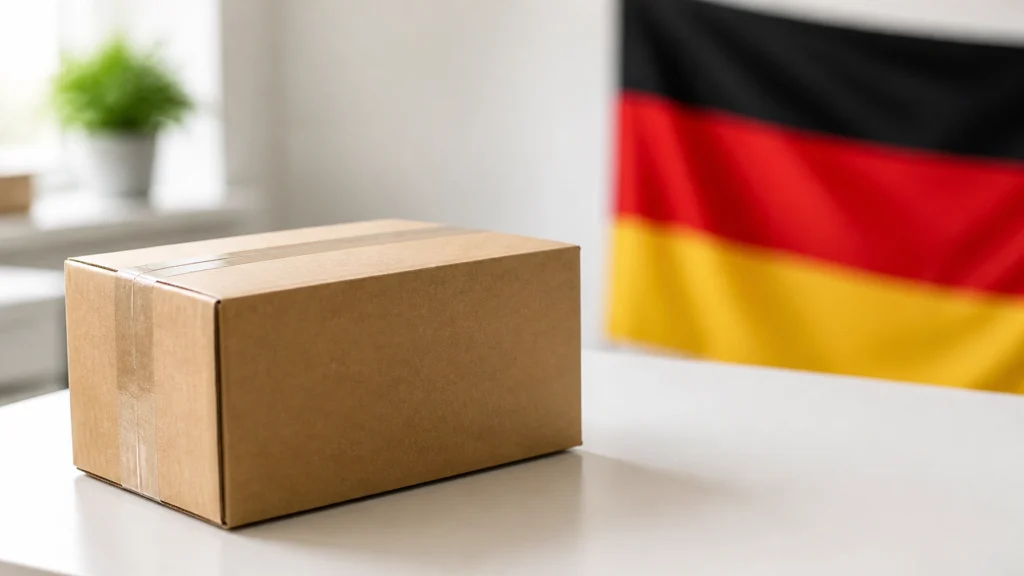
Easy parcel delivery to Germany from Greece is now a door-to-door affair: you book online, a courier collects from your address and the parcel is tracked all the way to Berlin, Munich, Hamburg or any German postcode.
Germany is the single busiest route out of Greece, driven by the Greek community, students and e-shop orders. This guide covers prices, transit times, packing, and the details that make the difference. CourierAPP ships to 220+ destinations worldwide through DHL and FedEx.
How easy parcel delivery to Germany actually works
There is no counter, no queue and no printed forms to fill in by hand. The whole booking takes around half a minute.
Choose Germany and the destination city. No account is needed to see a price, so you can check before deciding anything.
Enter both addresses. Type them, or photograph an existing shipping label or invoice and let the AI address scanner read them. You confirm the result before it is used.
Give weight and dimensions. Measure if you can. If not, one photo with a plain A4 sheet next to the box lets the AI estimate them for you.
Compare Economy and Express. Both appear with the final VAT-inclusive price, so the decision is transparent.
Book the collection and follow the tracking. The label arrives by email and a tracking number updates at every scan until delivery.
Prices for parcel delivery to Germany
Germany sits in the standard European zone, so pricing is predictable. All figures include VAT and reflect the live price list.
- 1 kg envelope or parcel, Express: €26.90
- 5 kg parcel, Economy: €49.90
- 10 kg parcel, Economy: €59.90
- 10 kg parcel, Express: €85.90
- 23 kg suitcase, Economy: €87.90
International shipping starts from €20.90 on the lightest routes. Notice how modest the step from 5 kg to 10 kg on Economy is compared with the jump from Economy to Express at the same weight.
That single observation is where most of the saving on this route comes from.
Delivery times: Express and Economy to Germany
Express normally delivers in 1 to 3 working days from collection. Economy normally delivers in 3 to 6 working days. Both are collected from your door and tracked at every handover.
Estimates exclude the pickup day and are counted in working days, so a Thursday collection with a German public holiday on the Monday loses more time than the number suggests.
Germany observes several regional public holidays that do not apply nationally. Bavaria and Baden-Wurttemberg in particular have days that Berlin does not.
For anything with a deadline, add a working week of margin during December and during the September and January student waves.
No customs: the quiet advantage of an EU route
Germany is inside the European Union, so there is no customs clearance and no import duty on personal shipments. Nothing is declared, nothing is held, nothing is charged at the door.
This is why easy parcel delivery to Germany is genuinely easier than shipping to the United Kingdom or the United States, where a declaration and possible import VAT enter the picture.
You still describe the contents in the app, because carriers need to know what is moving through their network, but that description is not a customs document on this route.
Commercial shipments above certain thresholds have their own rules, and an e-shop sending regular volume should treat those separately from personal parcels.
What you still cannot send
The absence of customs does not remove carrier restrictions. These apply on every route, including inside the EU.
- Loose lithium batteries and power banks.
- Aerosols, perfumes, alcohol and flammable liquids.
- Perishable food and anything requiring refrigeration.
- Cash, jewellery and documents of monetary value.
- Weapons, replicas and pressurised containers.
Olive oil is the classic Greek exception people ask about. Sealed, commercially packaged bottles are sometimes accepted, but home-bottled oil in a plastic container is not, and a leak ruins everything around it.
Packing for the German network
German delivery is dense, automated and fast, which is excellent for transit and unforgiving for weak boxes.
Use double-wall cardboard above roughly 5 kg. Single-wall is fine for clothing and light goods.
Keep contents a few centimetres from the outer walls and wrap fragile items individually rather than as a group.
Tape both top and bottom seams in an H pattern. Machines pull at edges, and a bottom seam taped after filling is the most common failure point.
Remove every old label and barcode. Automated scanners read whatever they see first, and a leftover code causes real misroutes.
Put a card with sender and recipient details inside the box as a backup if the outer label is destroyed.
German addresses: the details that matter
More failed deliveries on this route come from address formatting than from anything the sender packed.
Street name comes first and house number second: Hauptstrasse 12, not 12 Hauptstrasse. The postcode is five digits and precedes the city.
Apartment buildings need the surname exactly as it appears on the doorbell panel. German couriers rely on the bell label, not on the flat number.
Add the floor and, where relevant, the building or entrance letter. In large complexes this is what decides whether a driver finds the door.
Umlauts can be written as ae, oe and ue without problems, and strasse is safely written in full rather than abbreviated.
Six tips for easy parcel delivery to Germany
1. Right-size the box. Volumetric weight is charged when it exceeds actual weight, so empty space costs money. Cut down an oversized carton instead of padding it.
2. Weigh before booking. Every shipment is reweighed at the first hub, and an optimistic estimate is corrected afterwards. Guessing never saves anything.
3. Default to Economy. On an EU route with no customs step, the transit difference is a few days and the price difference is substantial.
4. Consolidate into one booking. Up to 10 parcels can travel on a single booking with one combined price and separate tracking per piece.
5. Give a German phone number if you have one. Drivers call, and an unanswered Greek mobile becomes a failed attempt.
6. Send the tracking number to the recipient immediately. Most delivery problems are solved by the person at the other end, not by the sender.
Multi-piece bookings: up to 10 parcels at once
The form has an Add parcel button, so one booking can carry up to 10 pieces. The price is combined and each piece gets its own tracking number.
On the Germany route this matters more than almost anywhere else, because so many shipments are moves rather than single parcels. Students relocating for a semester, families sending a season of clothing, e-shops sending a weekly batch.
One collection, one payment, one label set. It also allows you to split a heavy load across several right-sized boxes, which often lands in better weight bands than one large carton.
Who ships to Germany from Greece, and why
The Greek community in Germany is the largest in Europe, and the shipping patterns follow it closely.
Families send food that is not easily found abroad, clothing and documents, usually on Economy because nothing is urgent.
Students moving to German universities ship books, winter clothing and equipment in September and January, typically as multi-piece bookings.
Greek e-shops send orders to German customers year round, and for them the priority is a predictable transit estimate rather than the lowest possible rate.
Professionals send samples, spare parts and equipment, where Express earns its price because downtime costs more than the difference.
Tracking and what the statuses mean
Tracking on this route follows a predictable path: collected in Greece, origin hub, export, arrival in Germany, local depot, out for delivery.
Because there is no customs step, there is no customs status to worry about, which makes German tracking noticeably cleaner than non-EU routes.
A quiet day while the parcel moves between hubs is normal. A status that has not changed for several working days is worth a question.
Proof of delivery includes a timestamp and, in most cases, a signature. Ask for it if a recipient says nothing arrived.
Carrier-side detail on international express standards is published on the DHL Express website.
Common mistakes on the Greece to Germany route
Paying for Express when nobody was waiting. This is the single most expensive habit on an EU route where Economy is already reliable.
Using a box that is far larger than the contents, then being surprised by volumetric pricing.
Writing the address in Greek transliteration rather than German format, so the house number and street order are reversed.
Leaving the recipient uninformed, so nobody is home and nobody answers the phone.
Sending liquids or a power bank tucked into a bag of clothes, which stops the parcel regardless of destination.
Insurance and declared value
Every shipment travels with standard carrier liability, calculated by weight rather than by the value of the contents.
For clothing and everyday goods that is normally adequate. For anything worth more, declare the real value and add cover at the time of booking.
Photograph the contents laid out and the box sealed before it leaves, and keep receipts for valuable items. Claims are decided on documentation, not description.
If a parcel arrives damaged, note it at delivery and photograph the packaging before unpacking fully.
Returns, forgotten items and one-off shipments
Not every shipment is planned in advance. If a traveller leaves something behind at a hotel, villa or short-term rental in Greece, the return can be arranged online through the Lost and Found service.
The traveller pays and sees the final VAT-inclusive price before confirming. The property receives a prepaid label by email, hands the item to the courier and pays nothing at all.
Let the AI measure the box for you
If you have no tape measure, the app estimates dimensions from a single photo using a plain A4 sheet as a ruler, with a green frame guide to help line up the shot. It can also estimate weight from a description of the contents.
It is an assistant rather than a replacement: you confirm the numbers, and the carrier reweighs on collection so only the difference is ever adjusted. Photos are used solely to calculate the shipment.
See it explained in our guide to measuring a parcel from a photo, and compare nearby routes in shipping from Greece to Germany and cheap parcel delivery to Europe.
A checklist before you book
- Box is the smallest that safely fits the contents.
- Weight and all three dimensions measured, not guessed.
- Deadline decided before choosing Economy or Express.
- German address written street-then-number with a five-digit postcode.
- Surname matches the doorbell panel in apartment buildings.
- Recipient has the tracking number and expects the parcel.
- Nothing restricted inside.
- Old labels removed, both seams taped.
Major German cities and delivery patterns
Easy parcel delivery to Germany covers the whole country, but the experience differs slightly by region.
Berlin, Hamburg, Munich, Frankfurt and Cologne are dense metropolitan networks with the fastest last-mile delivery and the highest chance of a doorbell-panel address problem.
Stuttgart, Dusseldorf and Nuremberg behave similarly, with strong industrial volume and reliable business-hours delivery.
Rural Bavaria, parts of Mecklenburg and the eastern Lander can add a day on Economy, and remote-area handling occasionally applies to very isolated postcodes.
None of this changes the booking process. It only changes how much margin you should leave if something has a date attached to it.
Sending food and Greek products to Germany
This is the most common question on the route, and the answer is more nuanced than yes or no.
Dry, sealed, commercially packaged goods travel well: pasta, rusks, herbs, coffee, packaged sweets and vacuum-sealed items with a clear label and expiry date.
Liquids are the problem. Olive oil, honey, wine and homemade preserves are either restricted outright or arrive as a leak that damages everything around them.
Fresh and refrigerated products are not suitable for a standard courier network at all, because nothing in the chain is temperature controlled.
If you do send packaged food, double-bag it, keep it away from clothing and describe it accurately in the app.
Business shipping on the Germany route
For an e-shop, easy parcel delivery to Germany is less about the cheapest single rate and more about predictability.
Standardise on two or three carton sizes matching your typical order. Predictable dimensions mean predictable weight bands and far fewer billing surprises.
Batch collections into one daily slot rather than booking ad hoc. It cuts cost and it cuts the time somebody spends waiting for a driver.
Give German customers a transit estimate you can actually meet. Economy with honest expectations beats Express with an over-promise.
Track your own failure rate. Returns and failed attempts erode margin far more quietly than the headline rate does.
Students moving to Germany
September and January are the busiest weeks on this route, and the same mistakes repeat every year.
Book earlier than feels necessary. Collection slots fill and Economy transit stretches when volumes peak.
Split heavy and light: books and shoes in one dense box, clothes in a larger light one. Two balanced pieces in a multi-piece booking usually beat one overweight carton.
Send winter clothing in October rather than dragging it in September. Student rooms are small and the first shipment stays in a lower price band.
Use the university or residence address exactly as the institution writes it, including building and room number.
Germany compared with other European routes
Germany is the reference point for European pricing from Greece, so it is worth seeing where it sits against neighbours.
France, Italy, the Netherlands, Belgium, Spain and Austria share the same European zone and behave almost identically on transit and paperwork.
Cyprus is cheaper because of its own zone. The United Kingdom is more expensive because Brexit turned it into a customs route, and the United States is Express-led for the same reason.
So if you have priced easy parcel delivery to Germany, you have effectively priced most of mainland Europe. That makes it a useful benchmark when planning several shipments.
Choosing between shipping and carrying it yourself
People flying to Germany often weigh a courier against airline excess baggage. Both have a place.
Excess baggage is charged per piece and per kilo at the airport, at rates set by the airline, and paid under time pressure at the desk. You also carry everything through two terminals.
A courier collects from your door and delivers to the recipient address, and the parcel travels independently of you. It can leave before you or follow after.
For one bag on a short hop, airline excess is sometimes competitive. For two or more pieces, a one-way move, or when you are not flying at all, easy parcel delivery to Germany wins on both cost and effort.
Conclusion
Easy parcel delivery to Germany comes down to three decisions: the right box, an honest weight and the service that matches your deadline. There is no customs step to complicate any of it.
Book online, hand the parcel over at your door and follow it to a German address with full tracking from start to finish.
How much does easy parcel delivery to Germany cost from Greece?
A 5 kg parcel on Economy starts at €49.90 with VAT included, and a 10 kg parcel at €59.90. Express for 10 kg is €85.90. You see the exact amount before paying.
How long does parcel delivery to Germany take?
Express normally takes 1 to 3 working days from collection and Economy 3 to 6 working days. Estimates exclude the pickup day, and German regional public holidays can extend them.
Is there customs on easy parcel delivery to Germany?
No. Germany is inside the European Union, so personal shipments from Greece have no customs clearance and no import duty. You still describe the contents in the app, but there is no customs declaration on this route.