📦 Στείλε Δέμα — Δες Τιμή Άμεσα
Luggage Shipping Mistakes: 7 Costly Errors and How to Avoid Them
No Comments
Luggage shipping mistakes are the number one reason travellers pay extra fees, face delays or receive damaged belongings. A wrong measurement, an old barcode label or a single prohibited item can turn a simple shipment into an expensive adventure. Whether you are a student leaving for Erasmus, a family relocating abroad or a professional sending equipment to another country, this guide walks you through the 7 most common luggage shipping mistakes — and exactly how to avoid every one of them.

With the right preparation and a modern digital tool like CourierAPP, you can ship your suitcase door-to-door to 220+ destinations worldwide across Europe and the UK, saving both time and money. Let’s look at what usually goes wrong.
1. Shipping the suitcase “naked”, without protection
Many people assume a hard-shell suitcase is tough enough to travel on its own. In reality, courier networks move parcels on automated conveyor belts and sorting hubs where an unprotected suitcase gets scratched, stained, or loses wheels and handles. Worse, straps and telescopic handles can get caught in machinery and cause delays.
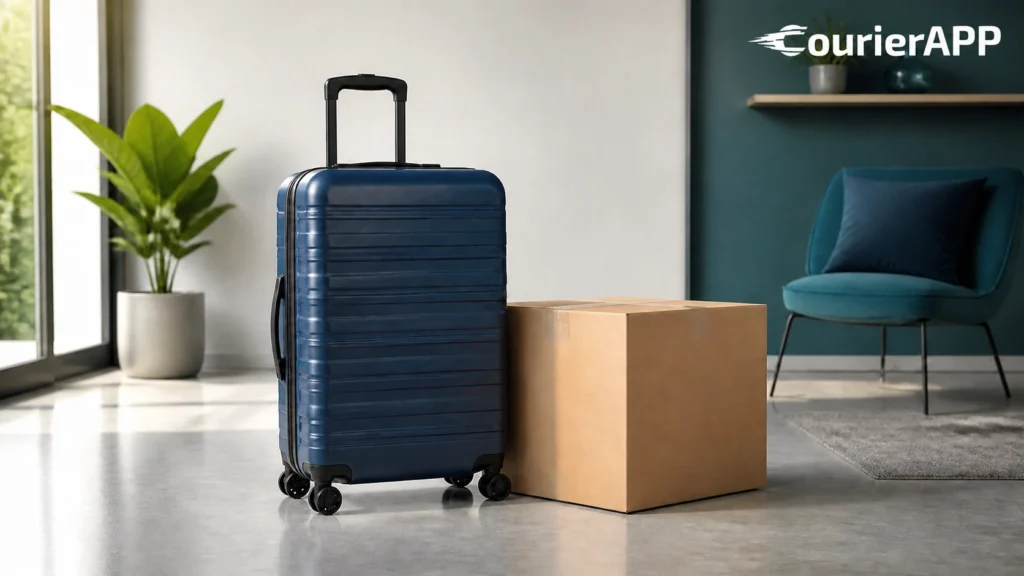
The fix: always place the suitcase inside a sturdy cardboard box. Reinforce the corners with tape, fill empty gaps with clothes or paper, and keep the outer surface flat and scannable. A boxed suitcase is also measured more accurately, which usually means a lower price.
2. Wrong weight and dimension measurements
Guessing the weight “around 15 kilos” is one of the most expensive luggage shipping mistakes you can make. Carriers re-weigh and re-measure every single shipment with certified scales and volumetric scanners. If your declaration is lower than reality, the difference is billed afterwards — often at a much less favourable rate.
The fix: weigh the packed box on a bathroom scale (weigh yourself with and without it) and measure the outer dimensions with a tape measure. Declare honest numbers. Transparent pricing with VAT from the start always beats a surprise adjustment invoice later.
3. The prohibited items trap
Aerosols, lighters, loose lithium batteries, flammable liquids, perishable food, cash and high-value jewellery do not belong in a shipped suitcase. A prohibited item discovered at a sorting hub can get your entire shipment stopped, returned or even destroyed — with no refund.
The fix: empty every pocket before packing. Keep batteries inside their devices, place permitted liquids in zip bags wrapped in clothes, and when in doubt, check the carrier’s restricted items list before booking. Two minutes of checking saves days of frustration.
4. Poor internal packing and the “shaken contents” effect
A suitcase that rattles is a suitcase that breaks. Contents shifting inside the box are the leading cause of damage claims in international shipping — and claims for badly packed shipments are routinely rejected.
The fix: fill every empty space. Use clothes, towels and paper as padding, put fragile items in the centre surrounded by soft layers, and close the box so the lid does not flex. Take photos of the packed contents before sealing; they are your evidence if you ever need compensation.
5. Old labels and barcode chaos
Suitcases collect stickers: airline tags, previous shipping labels, duty-free barcodes. Automated scanners read the first barcode they find — and if that is last year’s flight tag, your box may be routed to the wrong hub and travel in circles for days.
The fix: strip every old label, tag and sticker before shipping. Print the new label clearly, attach it flat on the largest surface, and put a second copy inside the box. If the outer label is ever damaged, the inner copy lets the carrier identify and deliver your shipment.
6. Ignoring customs rules after Brexit
Shipping to EU countries is paperwork-free, but the United Kingdom is a different story since Brexit. Shipments without a proper customs description get stuck, and vague declarations like “stuff” or “personal things” trigger inspections and storage fees.
The fix: for UK-bound luggage, describe the contents honestly — “used personal effects” is an accepted description for a relocation suitcase and usually clears without extra charges. Include realistic values, and allow one to two extra days for customs clearance. You can find the official customs guidance on the DHL website.
7. Queuing at the post office and paying retail rates
Carrying a 20-kilo suitcase to a post office branch, waiting in line and paying the walk-in retail tariff is the most common — and most expensive — of all luggage shipping mistakes. Retail counters charge up to 70% more than digital wholesale rates for exactly the same transport network.
The fix: book online. A courier picks the box up from your door at the time you choose, you pay wholesale prices with VAT included, and you track the shipment live on your phone from pickup to delivery.
Luggage shipping mistakes with volumetric weight: the hidden enemy
Carriers do not only charge the kilos on the scale; they also calculate volumetric weight with the formula (length × width × height in cm) ÷ 5000. Whichever number is higher is the one you pay for. A large half-empty box can be billed as 25 kg while the scale shows 12.
Measure the outer dimensions of the box — not the suitcase — and declare them precisely. Or let CourierAPP’s AI measure the parcel from a single photo, using an A4 sheet of paper as a reference ruler: you get a reliable starting estimate, which you confirm yourself before booking. Photos are used only to calculate the shipment, nothing else.
Remember: the carrier re-weighs every parcel, and only the difference is adjusted. Honest measuring from the start is always the cheapest strategy.
How long does it take? Delivery times and tracking
Most European capitals are reached in 2–5 working days; remote regions and islands take 5–8. The UK needs 1–2 extra days for customs clearance after Brexit. If you are relocating or starting a semester abroad, ship your luggage 7–10 days before you travel so it is waiting for you at the destination.
Live tracking shows every stage in real time: pickup, arrival at the sorting hub, customs, out for delivery. Avoid booking right before public holidays when networks are congested, and prefer Monday–Wednesday pickups for the fastest flow.
What is allowed — and what is banned — inside a shipped suitcase
Allowed: clothes, shoes, books, bedding, small appliances without lithium batteries, and personal items. Banned: aerosols, large quantities of perfume, lighters, loose lithium batteries, flammable liquids, perishable food, money and valuables. Liquids that are allowed should travel in zip bags, wrapped in clothing — one leaking shampoo bottle can ruin the entire contents, and leaks are not covered by compensation.
For shipments outside the EU, declare contents honestly. Understating value to dodge duties is a false economy: inspections catch it, and penalties cost far more than the duty itself.
Checklist: 10 steps to avoid luggage shipping mistakes
Run through this list before every shipment — it covers all the classic luggage shipping mistakes that cost money:
- Weigh the packed suitcase on a bathroom scale.
- Measure the outer box dimensions with a tape measure — or photograph it next to an A4 sheet for an AI estimate.
- Calculate volumetric weight and compare it with the actual weight.
- Remove all old labels, tags and barcodes.
- Place the suitcase in a sturdy cardboard box with reinforced corners.
- Remove prohibited items: batteries, aerosols, flammables.
- Seal liquids in zip bags.
- Print two label copies — one outside, one inside the box.
- Photograph the contents for any future claim.
- Check the final price with VAT before paying.
How to ship a suitcase step by step with CourierAPP
The whole process takes less than five minutes. Open the app, enter the destination country, weight and dimensions — or simply photograph the parcel and let the AI suggest the measurements. You see an instant price with VAT in about 30 seconds. Snap it. Ship it. Done.
Then choose a pickup day and time, pay online and print the label. The courier arrives at your door, scans the box, and from that moment you follow it live on your phone. If anything comes up — an address change, a customs question — support answers in human time.
New to international shipping? Start with our complete guide on how to ship a parcel from Greece for the fundamentals.
How much does it cost? Price factors and smart savings
The final price depends on four factors: destination, weight (actual or volumetric), service speed and seasonality. A 15 kg suitcase to Germany costs far less than most people expect — as long as you are not paying retail rates. Through a wholesale platform, the exact same premium network costs up to 70% less.
Always compare shipping against the airline’s excess baggage fee: low-cost carriers charge €60–90 per extra 23 kg bag per direction, while door-to-door shipping usually costs less and nobody drags wheels through metro stations. For a full cost breakdown, see our guide to luggage shipping from Greece.
Suitcase or cardboard box: which one wins?
An expensive wheeled suitcase travels safest inside a box, while a cheap one can go wrapped in protective film with reinforced handles. The box has a financial advantage too: regular dimensions are measured more accurately, there are no protruding parts to inflate the volumetric weight, and boxes stack better in sorting hubs, reducing damage risk. For relocations, 60×40×40 cm moving boxes are the most cost-efficient size per euro.
Students and Erasmus: a smart start
Students make the classic errors: shipping at the last minute, using an incomplete dorm address, ignoring destination rules. Confirm your residence accepts parcels before your arrival and ask for the exact address format — in Germany, the name on the doorbell is essential for delivery.
Smart tip: ship your winter clothes ahead and fly with hand luggage only. A cheap no-bag ticket plus a shipped box almost always beats paying for checked luggage — and you avoid the extra charges described in our guide on parcel shipping mistakes that trigger extra charges.
Insurance and compensation: what happens if something goes wrong
Every shipment carries basic carrier liability, but it covers a fixed amount per kilo — not the real value of your belongings. If you ship a laptop or camera, declare it and consider additional insurance; the cost is small compared to the risk.
For a valid claim you need photos of the contents before sealing, a photo of the sealed labelled box, and immediate damage notification on delivery. Without proper packaging most claims are rejected — one more reason never to ship a suitcase “naked”. In practice, with correct preparation, damage in organised international networks is rare.
Packing materials that actually protect your suitcase
Good materials cost a few euros and prevent most damage. Use double-wall cardboard boxes for anything over 15 kg — single-wall boxes collapse under stacking pressure in the truck. Brown packing tape beats transparent office tape; apply it in an H-pattern on top and bottom seams. Bubble wrap belongs around fragile items, never as the only outer protection.
Stretch film is the secret weapon of experienced shippers: three or four layers around the closed box add water resistance and keep the flaps sealed even if the tape fails. Corner protectors — or improvised cardboard corners — absorb the impacts that scratch hard-shell suitcases. All of it together usually costs under €10.
Timing your shipment: seasons, sales and holidays
Courier networks have seasons. September (student relocations), December (holidays) and August (summer moves) are peak months: pickup slots fill earlier, transit times stretch by a day or two. Book two or three days ahead in these periods.
January, February and May are quiet: pickups are available next-day and transit times are at their fastest. If your move is flexible, shipping in a quiet week is the simplest saving there is. Weather matters too — during heatwaves or storms, avoid leaving pickup for the last possible day before a deadline.
Real example: shipping a 20 kg suitcase from Athens to Berlin
Let’s put it all together. Maria is starting a master’s degree in Berlin. Her hard-shell suitcase weighs 20 kg packed; boxed, the outer dimensions are 80×50×40 cm. Volumetric weight: (80×50×40) ÷ 5000 = 32 kg — so she will be billed for 32 kg, not 20. Knowing this in advance, she repacks into a slimmer 75×45×35 box, drops the volumetric weight to 23.6 kg and saves real money before the courier even arrives.
She strips two old airline tags, seals her toiletries in zip bags, removes a power bank (lithium battery — banned), photographs the open box, and prints two label copies. The pickup happens Tuesday morning at her door in Athens; tracking shows the box in Leipzig on Thursday and delivered in Berlin on Friday — before her Sunday flight.
Total cost: less than half of what two excess baggage fees would have been, with no dragging 20 kilos through three metro transfers and two airports. That is what avoiding luggage shipping mistakes looks like in practice.
Why CourierAPP is the smart way to ship your luggage abroad
CourierAPP is the first Greek courier app with artificial intelligence. It scans the delivery address from a photo of a label or invoice, estimates parcel dimensions from a single photo with an A4 sheet as reference, estimates weight from a description of the contents, and returns an instant price with VAT in about 30 seconds. The AI is an assistant — you always confirm the numbers before booking.
Partnering with the world’s leading networks, CourierAPP offers door-to-door pickup across Greece, wholesale prices up to 70% below retail, transparent VAT-inclusive pricing and live tracking to 220+ destinations worldwide. Photograph. Send. Done.
\n
Luggage shipping mistakes: frequently asked questions
\n
What are the most common luggage shipping mistakes?
The most frequent luggage shipping mistakes are shipping the suitcase without a protective box, guessing weight and dimensions instead of measuring, packing prohibited items, leaving old barcode labels attached, and ignoring customs rules for the UK after Brexit.
How do I avoid luggage shipping mistakes with volumetric weight?
Measure the outer dimensions of the box and calculate (length × width × height) ÷ 5000. Whichever is higher — volumetric or actual weight — is what you pay. Alternatively, photograph the parcel next to an A4 sheet and let CourierAPP\u2019s AI produce a starting estimate you confirm before booking.
Do I have to put my suitcase in a cardboard box?
Yes. A sturdy box protects the suitcase on automated sorting belts, makes measuring more accurate, and is a precondition for a valid damage claim. Suitcases shipped unprotected are the top source of rejected compensation requests.
How many days does a shipped suitcase take within Europe?
Typically 2–5 working days for most European countries and 5–8 for remote areas. Add 1–2 extra days for UK customs clearance after Brexit.
\n
You now know how to avoid every one of the classic luggage shipping mistakes: proper packaging, honest measurements, clean labels and a VAT-inclusive price before you pay. Download the app, photograph your parcel and send your suitcase to 220+ destinations worldwide — fast, affordable and with zero surprises.